Your D&D class based off of your Hogwarts house
Ravenclaw: Wizard
Gryffindor: Wizard
Hufflepuff: Wizard
Slytherin: Wizard
Category: Uncategorized
Pride may be ending today but we still have 6 more months of 20gayteen and they gayness will only intensify after today.
Someone needed to remind us to stay strong and this guy stepped up when we needed him most
opinion: straight people CAN be cowboys (if theyre trans)
yes

Could somebody be a paramedic if they were missing a forearm?
Y’know, sometimes a question comes along that exposes your biases. I’m really, really glad you asked me this.
My initial instinct was to say no. There are a lot of tasks as a paramedic that require very specific motions that are sensitive to pressure: drawing medications, spreading the skin to start IVs. There’s strength required–we do a LOT of lifting, and you need to be able to “feel” that lift.
So my first thought was, “not in the field”. There are admin tasks (working in an EMS pharmacy, equipment coordinator, supervisor, dispatcher) that came to mind as being a good fit for someone with the disability you describe, but field work….?
(By the way, I know a number of medics with leg prostheses; these are relatively common and very easy to work with. I’m all in favor of disabled medics. I just didn’t think the job was physically doable with this kind of disability.)
Then I asked. I went into an EMS group and asked some people from all across the country. And the answers I got surprised me.
They were mostly along the lines of “oh totally, there’s one in Pittsburgh, she kicks ass” or “my old partner had a prosthetic forearm and hand, she could medic circles around the rest of her class”. One instructor said they had a student with just such a prosthesis, and wasn’t sure how to teach; the student said “just let me figure it out”, and by the end of the night they were doing very sensitive skills better than their classmates.
Because of that group I know of at least a half-dozen medics here in the US with forearm and hand prostheses.
So yes. You can totally have a character with one forearm, who works as a paramedic for a living.
Thanks again for sending this in. It broadened my worldview.
xoxo, Aunt Scripty
The Script Medic is supported by
generous donations on Patreon. Have you considered donating?THANK YOU, from the disability community, for doing the actual research and not just relying on your first assumptions and stereotypes.
Organization of nurses with disabilities: http://nond.org/
Association of medical professionals who are deaf or hard of hearing: https://amphl.org/
When I was growing up, I was around people who were mostly pretty good at staying positive about my range of career options as a deaf person and who encouraged me to dream big. But one of the few things I was told that I likely couldn’t do would be to be a doctor. This is because they weren’t sure how to work around the “need” to listen to certain things through a stethoscope. No, it didn’t have a real impact on my career-related decision making because I didn’t really have an interest in the medical professions anyway, my interests took me in other directions. But it was one of the few limits that some people put on my vision, and even though it didn’t have a practical impact on me I still felt the constraint a bit – just the idea that something random like a stethoscope could potentially shut me out from an entire field.
Now flash forward to when I’m in my 20s, back when I was interviewing people and writing articles for a university staff/faculty publication and alumni outreach magazine. And one day I find myself interviewing a deaf EMT for an article I was writing on deaf women working in various professions related to the various sciences. And this deaf EMT had a specialized stethoscope designed to be SO LOUD that even I, a severely to profoundly deaf person, could actually hear a beating heart or the sound of nerves working! And that was with putting the buds for the stethoscope directly into my ears, which meant that I actually took out my hearing aids in order to listen instead of having to figure out how to get headphones to directly funnel sound into the eeny tiny microphone in my hearing aid. The kind of headphones designed with buds going directly into the ear just DO NOT WORK FOR THAT, period full stop. And most things designed for hearing people DO NOT WORK for deaf people because they only use the little bitty baby amplification that hearing people use to protect their incredibly fragile ears that start to hurt at just about the point I’m starting to be able to hear that there even IS a sound to be heard. Hearing people run in terror from the kind of BIG LOUD amplification that us deaf people need. (Unless they are the kind of rock music fans who think all good music ends with actual, noticeable hearing loss at the end of the concert.) And on top of that, most things designed for hearing people naturally don’t compensate for the fact that I hear low pitch sounds MUCH better than high pitch sounds. Meaning, I can actually hear low pitch sounds if they are amplified loud enough, but for high pitch sounds – well, the first 32 years of my life they basically didn’t exist in my life, for the past 14 or 15 years the only reason I can hear high pitch sounds is because these days, with the advent of digital (not just analog) hearing aids, it’s now possible to have hearing aids that take high pitch sounds and process them so they sound like low pitch sounds. So this is what water sounds like! When it’s processed so that it’s actually something I can hear. But somehow this stethoscope–invented when (most? or all?) of us deaf folks were still wearing analog hearing aids–managed to be loud enough for me.
Until the deaf woman EMT loaned me her stethoscope for a minute and explained it to me, I didn’t even know that you could actually hear the nerves working, not just the heart or breath in the lungs! And never imagined actually hearing it myself
And the deaf EMT told me that, for deaf people who really can’t hear anything at all even with that LOUD stethoscope, there are other machines to pick up basically the same information that you can get through a stethoscope. And she also pointed out that’s a fairly small part of being a doctor or EMT, anyway. You don’t have to be able to use a stethoscope to join the medical professions.
And … somehow, even though I had never personally actually wanted to be a doctor anyway, and still don’t want to, and still don’t miss having tried it, it was still so awesome realizing that this one last barrier that had been put on my old childhood imagination could just fade away.
People need to know.
PEOPLE NEED TO KNOW.
That people with disabilities can do all kinds of things
THAT people with disabilities ARE ALREADY DOING all kinds of things.
Because … on one hand, yes, there are a FEW things that people with certain disabilities actually can’t do. They do not yet have driverless cars on the open market for everyone to buy, so until that’s ready, blind people still can’t do jobs that by definition have to involve driving (like taxi cab driver, bus or truck driver, etc). And deaf people can’t be phone operators. And although deaf people could translate between written languages, and although there are certified deaf interpreters who translate between signed languages (yeah that’s an actual thing), people who are really deaf (and not just a little hard of hearing) can’t interpret between spoken languages on the phone.
But most of the things that people THINK are impossible for people with disabilities to do? Can be worked around with the right technologies, devices, software, adaptations, and a little resourcefulness and creativity.
More people need to be like @scriptmedic, meaning they need to do the work to actually research the options and find out what is already being done. And they need to talk with people who have the actual disability to see what ideas they have. Because we often have a lot of these ideas, and we often see some of our supposedly more “innovative” ideas as being actually rather boring and ordinary because we’ve been doing them since before our memories even start. Just by example – As far as I can tell, from the bits I know (I’ve only known a few adults without hands at all well), many babies born without arms seem to just naturally do all kinds of things with their feet instead, because that’s what they have to explore the world with. It seems like a “gee whiz” creative answer for people who haven’t needed to adapt to life without arms, but isn’t so innovative from the perspective of an adult who has been doing all kinds of stuff with their feet literally since infancy. As a deaf person who has been using writing as a tool of communication since, like, age 7 or something, it baffles me when I still occasionally meet hearing adults who seem to find the idea remarkable. And all that is before you even get to the stuff where we have to actually work to come up with a solution, by drawing upon more sophisticated adult experience, knowledge of available technologies, and opportunity to talk with other adults with similar disabilities who are working to solve things too. We usually have a lot, a lot of practice working to come up with solutions for things we haven’t tried before, so we are often likely to see solutions that everyone else misses–and not just for disability related accommodations.
People with disabilities don’t want to set themselves up to fail any more than anyone else. So if they seem to believe there’s a way for them to do it, you should give them a chance to show you, or explain what they’ve already been doing in the past, or explain what they’ve seen other people with the same disability do, or explain what ideas they have that they would like a chance to try out. Don’t just assume and then stop trying. Talk to us.
This. All of this.
Are you looking at creating a disabled character? Then you need to think not about what they can or can’t do, but about how they might approach the same task with different tools at their disposal.
Don’t say “X can’t do Y or Z”. First, ask, “what is actually NEEDED to do Y? What’s the process? How could I adapt it?”
I’ll be the first to say that medicine is an ableist community. We are. We almost have to be, because the whole point of medicine is to reduce disability and disease. We assume total health is the baseline, that other states are “abnormal” and to be corrected.
And sometimes that leads to misunderstandings. Misconceptions. False assertions.
And I’m going to tell you this, because I think @andreashettle would like to know this: I am, functionally speaking, a person with “normal” hearing. (I have a very slight amount of loss from working under sirens for a decade, but functionally I do just fine).
But you know what? I’ve never heard the sound of nerves. Never. I didn’t even realize that that is a sound you can hear.
So you, with your deaf ears, just taught me something about a tool I use every. single. day. of. my. life. About a sound I’ve never heard, with my “normal” ears and my “normal” stethoscope. (Okay, it’s a pretty kick-ass stethoscope, lezzbehonest rightnow.)
And for the love of all that is holy, I want to see these characters in fiction. Deaf doctors, one-handed medics, bilateral amputees running circles around other characters just to prove that they can.
I apologize for my misconception, for assuming that disability meant “can’t”. It’s a cultural part of medicine that I dislike. But now that I know it’s a thing I want to see it everywhere.
But if you’re going to do it… do the godsdamned research. Have respect for those who live with disabilities. Write better. Write real.
And above all? Write respectfully.
xoxo, Aunt Scripty
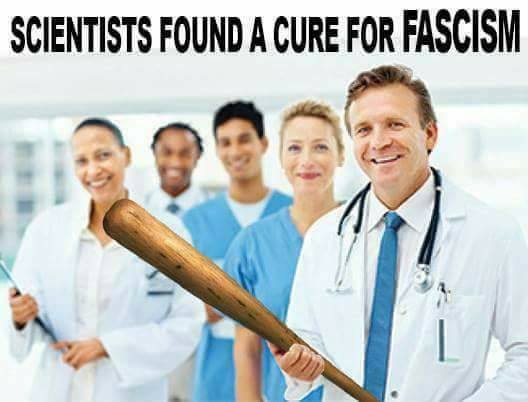
why am I chuckling so hard
The cure for fascism is… politically-motivated threats of brutal physical violence?
That’s literally fascism.
Yeah, remember how we defeated fascism in WW2 through polite conversation



Archaeologists stumble on Neolithic ritual site in Suffolk
As diggers began to strip the daisies and buttercups and carve down through the parched clay of a field near Woodbridge in Suffolk that sloped down to a riverbank, with archaeologists watching over the pretty but apparently featureless site, something extraordinary began to emerge. Clear spring water came bubbling from the ground, and with it came massive timbers preserved so perfectly that tool marks were still visible and stake posts were sharply pointed.
The archaeologists first thought the timbers must be medieval or even Victorian, and were puzzled to find them so deeply buried. But as 30 metres of timber track were exposed, alongside other unexpected objects too, such as the massive horns and skull of an aurochs, an extinct breed of giant cattle, they realised they were dealing with something far more ancient. The timbers were 4,300 years old, according to the first carbon-14 tests, and underlying ones may be much older.
The Neolithic trackway, which had evidence of being repeatedly restored and renewed over decades and probably generations, seems to have led up to a level timber platform, with spring water deliberately channelled to surround it. From the platform, objects were dropped into the running water, including metal, pottery and the horned aurochs skull. The skull had been carefully shaped either to fix to a pole or use as part of a headdress – and as the archaeologists who had to lift and carry it down the hill could testify, lugging it to the site would have taken considerable effort.
The skull was already ancient when it went into the water – tests dated it to about 2,000 years older than the track. Masses of white pebbles that would have been brought specially to the site were also found.On a recent scorching day, the trackway level of the site was still sodden. “You can’t stop the water,” archaeologist Vinny Monahan said. “We came upon evidence of various attempts to drain the field, but it bubbles up wherever you dig.”Prehistorians and ancient timber experts visited the site, and their opinion and the dating evidence bears out the realisation that the archaeologists had stumbled upon a major site of which not a trace remained in the historical record, despite evidence of Roman, Saxon and medieval occupation of the site. They now realise they did not pay enough attention when they were told that the traditional name of the field was Seven Springs.
Archaeologists are nervous of using the word “ritual”, but in this case, Monahan said, it is unavoidable: the people who used the site “weren’t living here – they made this place deliberately and they were coming here because it was important to them.”
Bolding mine. A skull that’s 6,500 years old, gone into the waters? That’s some Deep Time.
I mentioned some time ago that water is a portal, and has been recognized as such for thousands of years.
This sort of practice…placing sacrifices into water…is a recognition of that fact. A huge number of artifacts in Stone, Bronze and Iron Age Europe have been recovered from water or bogs, and they were placed there because it was known that water was important, and that springs and ponds and rivers were a sort of access point between worlds.
Think of bog bodies. Of things like this. Of swords, bent into circles and thrown into water. Of gold and jewelry, given to the water and found by archaeologists thousands of years later. Pottery. Food.
All given to the other worlds, by being sunk into bodies of water.
On the Yucatan the Maya used cenotes for the same purposes.
Yep.
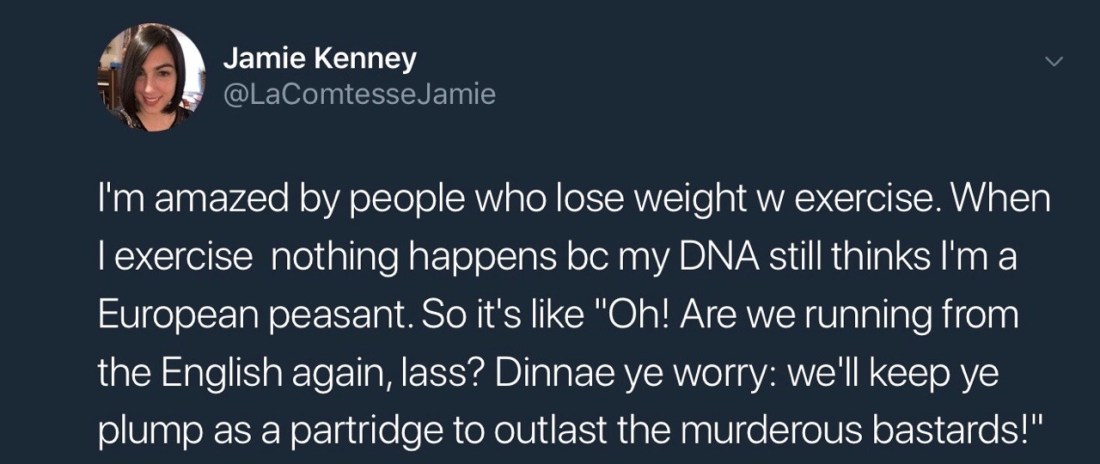
From Twitter.
is it weird that as i got through the tweet my understanding of it lessens?
If you had a recent ancestor who went through starvation it actually altered their genetics and may have passed down genes to you that make you hold on to fat. So this tweet is more accurate than you’d think.
Seriously, my body is expecting the next ice age.
OH MY FUCKING GOD.
MY FUCKING GREAT GRANDFATHER LITERALLY FLED LEBANON DUE TO A FUCKING FAMINE AND MY GRANDMOTHER AND DAD AND I ARE ALL FAT AS FUCKING HELL.
FUCK ME RUNNING I DID NOT KNOW THIS.
…That’s going to apply also to anyone whose recent ancestors voluntarily dieted a lot, isn’t it. Diet culture long-term causes more obesity. Sure, it takes decades to show up, but anything you’d hear today about childhood obesity would reflect that. Exercising is still very good for most people, but trying to lose weight shouldn’t be the goal for most people, because a) it usually doesn’t work very well or it comes back and b) your kids or grandkids could end up with extra wonky metabolisms. (And while fat itself is actually not that much of a problem if you keep your fitness up, it can be hard on your joints. That’s actually the biggest health risk if you’re “small end of fat,” under 40, and active–joint problems.)
THAT MOTHERFUCKING ARTIFICIAL FAMINE THAT’S IT I’M GONNA FIGHT THE ENGLISH
Honestly, “I’m gonna fight the English” is a good reaction to a lot of things.
the ‘obesity epidemic’ in america is probably due to a combo of our grandparents living through the great depression and our parents being teens and young adults during the days of twiggy and heroin chic and the rise of diet culture.
combine that with the fact that gen x was the last generation allowed to play outside, pretty much, and the fact that everybody nowdays is working service jobs that exhaust them without working their muscles, and there is basically no way on earth you’re going to get a fit and healthy population without changing the basic structure of our society.
don’t fall for the hype. don’t focus on weight. it’s actually far more dangerous to be underweight than overweight. even with what is clinically defined as ‘morbid obesity’ it’s possible to be healthy as a horse, if your bone structure and metabolism are set up for it and you’ve got lots of muscle to support it.
on top of that, the charts for ideal weight are at least a generation out of date. they were compiled based on a population that didn’t regularly get enough dairy and fresh produce, at a time when girls didn’t do athletics in school. young women in the 1960′s were measurably smaller than young women today. their bones were thinner, they had less muscle mass, their shoulders were more sloped, they had a smaller lung capacity – society discouraged them from being physically active past the age of ten or twelve, and they finished their physical development in a sedentary setting.
boys were plenty active, but just like the girls, they were eating just about nothing but red meat and starch and some mushy greens with the vitamins boiled out. the thing where the poor get fat because sugar and fat are cheap wasn’t really happening yet, especially in rural areas; a farm kid’s diet was beef and wheat in the north, pork and corn in the south. “eat your vegetables” was such a hard sell because everything else was expensive and bland and overcooked. you’ve seen the godawful cookbook excerpts from that time. mushy green beans and fried spam on a bed of mashed potatoes, seasoned with nothing but a pinch of white pepper.
sorry, that was kind of a tangent. i guess my point is, even the people who ate well by the standards of the time were malnourished compared to the standard of today. your lunch of a matcha cucumber smoothie and a cobb salad with one ounce of ham, one ounce of turkey, and 15 kinds of fresh vegetable, would give them the explosive shits because they’ve never had that much fiber in one place before. there’s more vitamins and antioxidants in your black bean fajita dinner than they saw in a week.
so first of all, the idea of trying to be the same size and shape they were is absurd.
and second, if malnourishment in one generation primes the next two for protective fat retention, the combination of that and the incredible wealth of nutrition we have available to us today is obviously going to make us HYUGE.
instead of fighting it, we should embrace it. we could all be HUMAN BOULDERS OF MIGHT.
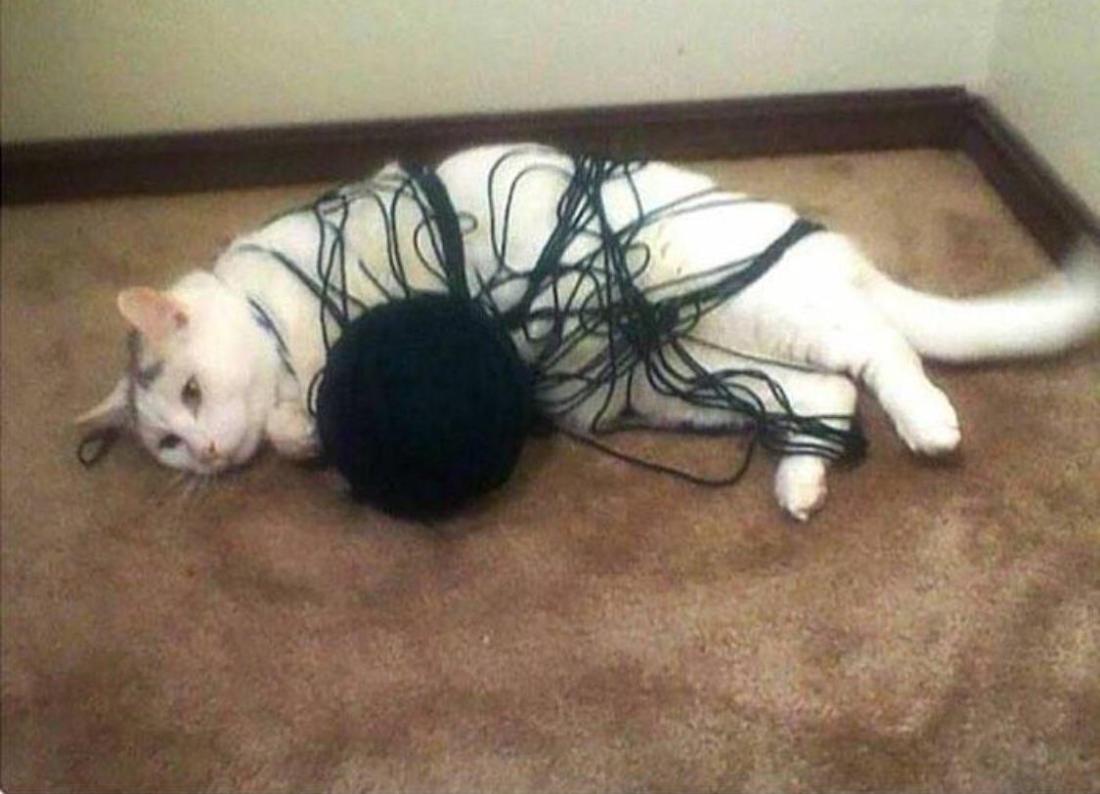
She didn’t anticipate the yarn fighting back (Source: https://ift.tt/2yTYHNX)
That is the face of defeat
 The Chaos Bitches