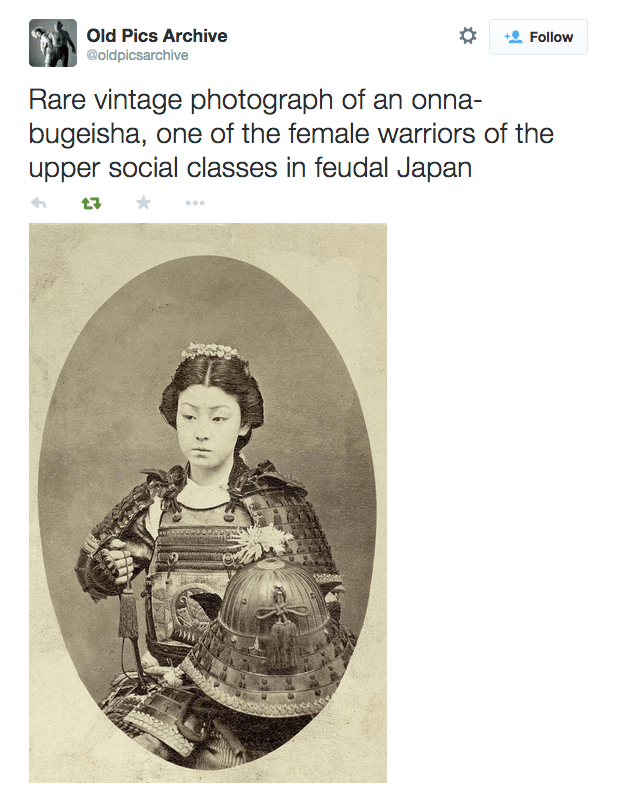
An onna-bugeisha (女武芸者) was a type of female warrior belonging to the Japanese upper class. Many wives, widows, daughters, and rebels answered the call of duty by engaging in battle, commonly alongside samurai men. They were members of the bushi (samurai) class in feudal Japan and were trained in the use of weapons to protect their household, family, and honour in times of war. They also represented a divergence from the traditional ‘housewife’ role of the Japanese woman. They are sometimes referred to as female samurai. Significant icons such as Empress Jingu, Tomoe Gozen, Nakano Takeko, and Hōjō Masako are famous examples of onna bugeisha. (x)
Female warriors have always been present in every battle for all of history. We never know when we may be called upon to protect ourselves. Answer the call. Train and fight to be ready for anything.
Require new parents to sign up for classes that teach them the proper ways to take care of their children and show the effects of dangerous parenting
Provide birth control for all genders and sexes, condoms for all genders and sexes and sexualities, and abortions free of charge
Require sex-ed-like classes for 5th graders and 9th graders that teach them how to know if they’re in an abusive household, how to know if their friends are in an abusive situation, how to escape or keep themselves safe, and how to help another person in an abusive situation
Teach teachers to recognize abuse victims
Tax the rich and eliminate the wage gap
Provide free therapy to victims of child abuse
Provide free therapy to perpetrators of child abuse, including the ones who are imprisoned
Reward children monetarily for succeeding in school so they have a willingness to learn and have less of a power imbalance with their parents
Change the legal definition of abuse to include emotional abuse of all forms such as constant insults, hover parenting, neglecting or overprotecting children, and constant yelling and screaming
Protect and enforce lgbtq rights and especially trans rights
Protect and enforce poc rights
How not to prevent abuse:
Get rid of participation trophies because children’s self worth doesn’t “build character”
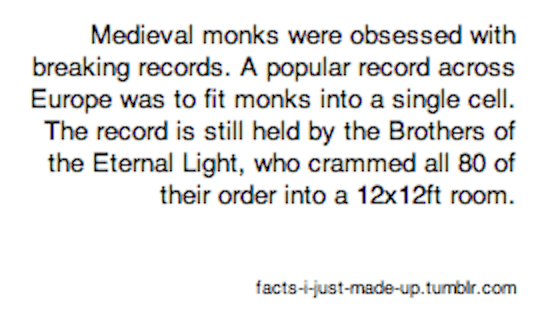
If all of them are under six feet, with shoulders roughly a foot and a half to two feet wide, this could be easily feasible. If all of them are exactly six feet tall, with 1.5 foot wide folder, sixteen monks could all lay snugly on the ground without much unused space. 80 divided by 16 is 5, so this setup of monks, in stacks of five, would fit eighty monks into this room. Assuming each monk is a little portly, at 1.5 feet from back to stomache, this hypothetical monk stack would be 7.5 feet tall.
Apologies to those who use metric. I am but a filthy North American Goblin.
But the reality was far more gruesome.
The year was 1261 and the Abbey of The Woeful Brothers of Solemnity had just crammed 72 of their 78 brothers into a 16×14 cistern. Word crossed christendom and Brothers of Eternal Light lost their previous record, which had been secured, they thought forever, in the name of the greatest glory of Christ. Abbot Maritus Tollok resigned in shame. The brotherhood redoubled their efforts but could not cram more than 68 monks into their next smallest room, the 12×12 washroom.
The new Abbot, Phillip Manlibum, refused to let the Woeful Brothers of Solemnity have their day. He realized that the human body was not shaped efficiently- Its arms specifically occupied much horizontal space that they did not completely fill, lowering the effective density of monk-cramming. So he did what any good abbot would do: He mandated the dismemberment of each monk in his order.
Each brother gave up his arms, which were sawed off by the immediate elder brother by his side. As the eldest of the order, Abbot Manlibum sawed off his left arm, and then, placing the saw in his severed left arm, sawed off his right in a grotesque spectacle that chronicles list as “The vibrating shaking arm dance of cauterizing disarmament,” on which the popular children’s dance “The Hokey Pokey” was later based. And so 70 monks fit into the washroom, two less than was needed to match the record.
Coincidentally, 1261 marked the year of several important inventions, including the fountain pen, the spoked wheel, and most relevant to our tale, liquid clog remover. The first liquid clog remover, “Dreighneaux,” was created by the alchemist Nicholas Flamel in an attempt to dissolve gold. It did not dissolve gold, but did a great job of removing hairballs from plumbing. And of dissolving human flesh. Abbot Manlibum heard wind of the substance, and quickly purchased enough to dissolve 20% of his order.
And so, until all 80 monks could fit into the washroom, the abbot ordered brother after brother to take the “Sacred Second Baptism Of Final Equilibrium.” In liquid form, the brothers fit easily into the washroom basin and the order reclaimed its record. The abbot was then arrested for murder and lived out his days in an 8×6 cell, 2ft larger than his cell at the monastery, into which he claimed he could fit 98 monks, given a proper crematorium and distillery.
Pope Nicholas III declared shortly after that monks could not participate in contests, record breaking, or any other such activity; nor could they mortify the body for any purpose beyond the spiritual. So the record stands to this day, liquid clog remover gained a significant reputation as being able to dissolve any material, and no monks have since dismembered themselves, melted each other, or otherwise destroyed their bodies for any reason but the glorification of our lord Jesus Christ,






 The Chaos Bitches