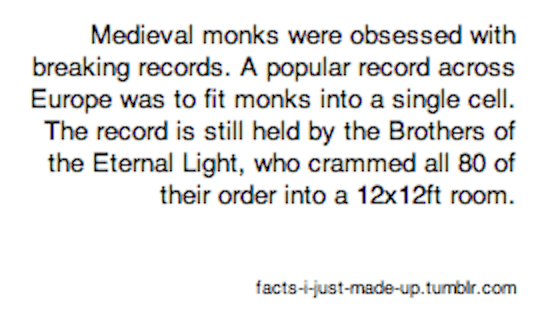
If all of them are under six feet, with shoulders roughly a foot and a half to two feet wide, this could be easily feasible. If all of them are exactly six feet tall, with 1.5 foot wide folder, sixteen monks could all lay snugly on the ground without much unused space. 80 divided by 16 is 5, so this setup of monks, in stacks of five, would fit eighty monks into this room. Assuming each monk is a little portly, at 1.5 feet from back to stomache, this hypothetical monk stack would be 7.5 feet tall.
Apologies to those who use metric. I am but a filthy North American Goblin.
But the reality was far more gruesome.
The year was 1261 and the Abbey of The Woeful Brothers of Solemnity had just crammed 72 of their 78 brothers into a 16×14 cistern. Word crossed christendom and Brothers of Eternal Light lost their previous record, which had been secured, they thought forever, in the name of the greatest glory of Christ. Abbot Maritus Tollok resigned in shame. The brotherhood redoubled their efforts but could not cram more than 68 monks into their next smallest room, the 12×12 washroom.
The new Abbot, Phillip Manlibum, refused to let the Woeful Brothers of Solemnity have their day. He realized that the human body was not shaped efficiently- Its arms specifically occupied much horizontal space that they did not completely fill, lowering the effective density of monk-cramming. So he did what any good abbot would do: He mandated the dismemberment of each monk in his order.
Each brother gave up his arms, which were sawed off by the immediate elder brother by his side. As the eldest of the order, Abbot Manlibum sawed off his left arm, and then, placing the saw in his severed left arm, sawed off his right in a grotesque spectacle that chronicles list as “The vibrating shaking arm dance of cauterizing disarmament,” on which the popular children’s dance “The Hokey Pokey” was later based. And so 70 monks fit into the washroom, two less than was needed to match the record.
Coincidentally, 1261 marked the year of several important inventions, including the fountain pen, the spoked wheel, and most relevant to our tale, liquid clog remover. The first liquid clog remover, “Dreighneaux,” was created by the alchemist Nicholas Flamel in an attempt to dissolve gold. It did not dissolve gold, but did a great job of removing hairballs from plumbing. And of dissolving human flesh. Abbot Manlibum heard wind of the substance, and quickly purchased enough to dissolve 20% of his order.
And so, until all 80 monks could fit into the washroom, the abbot ordered brother after brother to take the “Sacred Second Baptism Of Final Equilibrium.” In liquid form, the brothers fit easily into the washroom basin and the order reclaimed its record. The abbot was then arrested for murder and lived out his days in an 8×6 cell, 2ft larger than his cell at the monastery, into which he claimed he could fit 98 monks, given a proper crematorium and distillery.
Pope Nicholas III declared shortly after that monks could not participate in contests, record breaking, or any other such activity; nor could they mortify the body for any purpose beyond the spiritual. So the record stands to this day, liquid clog remover gained a significant reputation as being able to dissolve any material, and no monks have since dismembered themselves, melted each other, or otherwise destroyed their bodies for any reason but the glorification of our lord Jesus Christ,
Amen.
Ari.
What.

 The Chaos Bitches