sometimes i think i miss high school and then..this is pretty accurate
one time i was in class in middle school and i was eating a beef jerky slim jim and the teacher said “stop eating that unless you have enough to share” so i pulled out a box of 200 slim jims (from costco of course) and the teacher fucking confiscated it.
side note: perfect example of “is that your real objection?”
my dad is the mc for my cousins wedding and him and my mom are doing some “marriage is the end…..am I right fellas?!” Type banter for the audience but then my grandpa gets up in the middle of it and yells “no!!! You have to be nice to your wife all the time!!! All the time!!”
for his second Magnus Chase book, due to the inclusion of the character Alex Fierro who is gender fluid. This was the speech he gave, and it really distills why I love this author and his works so much, and why I will always recommend his works to anyone and everyone.
“Thank you for inviting me here today. As I told the Stonewall Award Committee, this is an honor both humbling and unexpected.
So, what is an old cis straight white male doing up here? Where did I get the nerve to write Alex Fierro, a transgender, gender fluid child of Loki in The Hammer of Thor, and why should I get cookies for that?
These are all fair and valid questions, which I have been asking myself a lot.
I think, to support young LGBTQ readers, the most important thing publishing can do is to publish and promote more stories by LGBTQ authors, authentic experiences by authentic voices. We have to keep pushing for this. The Stonewall committee’s work is a critical part of that effort. I can only accept the Stonewall Award in the sense that I accept a call to action – firstly, to do more myself to read and promote books by LGBTQ authors.
But also, it’s a call to do better in my own writing. As one of my genderqueer readers told me recently, “Hey, thanks for Alex. You didn’t do a terrible job!” I thought: Yes! Not doing a terrible job was my goal!
As important as it is to offer authentic voices and empower authors and role models from within LGBTQ community, it’s is also important that LGBTQ kids see themselves reflected and valued in the larger world of mass media, including my books. I know this because my non-heteronormative readers tell me so. They actively lobby to see characters like themselves in my books. They like the universe I’ve created. They want to be part of it. They deserve that opportunity. It’s important that I, as a mainstream author, say, “I see you. You matter. Your life experience may not be like mine, but it is no less valid and no less real. I will do whatever I can to understand and accurately include you in my stories, in my world. I will not erase you.”
People all over the political spectrum often ask me, “Why can’t you just stay silent on these issues? Just don’t include LGBTQ material and everybody will be happy.” This assumes that silence is the natural neutral position. But silence is not neutral. It’s an active choice. Silence is great when you are listening. Silence is not so great when you are using it to ignore or exclude.
But that’s all macro, ‘big picture’ stuff. Yes, I think the principles are important. Yes, in the abstract, I feel an obligation to write the world as I see it: beautiful because of its variations. Where I can’t draw on personal experience, I listen, I read a lot – in particular I want to credit Beyond Magenta and Gender Outlaws for helping me understand more about the perspective of my character Alex Fierro – and I trust that much of the human experience is universal. You can’t go too far wrong if you use empathy as your lens. But the reason I wrote Alex Fierro, or Nico di Angelo, or any of my characters, is much more personal.
I was a teacher for many years, in public and private school, California and Texas. During those years, I taught all kinds of kids. I want them all to know that I see them. They matter. I write characters to honor my students, and to make up for what I wished I could have done for them in the classroom.
I think about my former student Adrian (a pseudonym), back in the 90s in San Francisco. Adrian used the pronouns he and him, so I will call him that, but I suspect Adrian might have had more freedom and more options as to how he self-identified in school were he growing up today. His peers, his teachers, his family all understood that Adrian was female, despite his birth designation. Since kindergarten, he had self-selected to be among the girls – socially, athletically, academically. He was one of our girls. And although he got support and acceptance at the school, I don’t know that I helped him as much as I could, or that I tried to understand his needs and his journey. At that time in my life, I didn’t have the experience, the vocabulary, or frankly the emotional capacity to have that conversation. When we broke into social skills groups, for instance, boys apart from girls, he came into my group with the boys, I think because he felt it was required, but I feel like I missed the opportunity to sit with him and ask him what he wanted. And to assure him it was okay, whichever choice he made. I learned more from Adrian than I taught him. Twenty years later, Alex Fierro is for Adrian.
I think about Jane (pseudonym), another one of my students who was a straight cis-female with two fantastic moms. Again, for LGBTQ families, San Francisco was a pretty good place to live in the 90s, but as we know, prejudice has no geographical border. You cannot build a wall high enough to keep it out. I know Jane got flack about her family. I did what I could to support her, but I don’t think I did enough. I remember the day Jane’s drama class was happening in my classroom. The teacher was new – our first African American male teacher, which we were all really excited about – and this was only his third week. I was sitting at my desk, grading papers, while the teacher did a free association exercise. One of his examples was ‘fruit – gay.’ I think he did it because he thought it would be funny to middle schoolers. After the class, I asked to see the teacher one on one. I asked him to be aware of what he was saying and how that might be hurtful. I know. Me, a white guy, lecturing this Black teacher about hurtful words. He got defensive and quit, because he said he could not promise to not use that language again. At the time, I felt like I needed to do something, to stand up especially for Jane and her family. But did I make things better handling it as I did? I think I missed an opportunity to open a dialogue about how different people experience hurtful labels. Emmie and Josephine and their daughter Georgina, the family I introduce in The Dark Prophecy, are for Jane.
I think about Amy, and Mark, and Nicholas … All former students who have come out as gay since I taught them in middle school. All have gone on to have successful careers and happy families. When I taught them, I knew they were different. Their struggles were greater, their perspectives more divergent than some of my other students. I tried to provide a safe space for them, to model respect, but in retrospect I don’t think I supported them as well as I could have, or reached out as much as they might have needed. I was too busy preparing lessons on Shakespeare or adjectives, and not focusing enough on my students’ emotional health. Adjectives were a lot easier for me to reconcile than feelings. Would they have felt comfortable coming out earlier than college or high school if they had found more support in middle school? Would they have wanted to? I don’t know. But I don’t think they felt it was a safe option, which leaves me thinking that I did not do enough for them at that critical middle school time. I do not want any kid to feel alone, invisible, misunderstood. Nico di Angelo is for Amy, and Mark and Nicholas.
I am trying to do more. Percy Jackson started as a way to empower kids, in particular my son, who had learning differences. As my platform grew, I felt obliged to use it to empower all kids who are struggling through middle school for whatever reason. I don’t always do enough. I don’t always get it right. Good intentions are wonderful things, but at the end of a manuscript, the text has to stand on its own. What I meant ceases to matter. Kids just see what I wrote. But I have to keep trying. My kids are counting on me.
So thank you, above all, to my former students who taught me. Alex Fierro is for you.
To you, I pledge myself to do better – to apologize when I screw up, to learn from my mistakes, to be there for LGBTQ youth and make sure they know that in my books, they are included. They matter. I am going to stop talking now, but I promise you I won’t stop listening.”
Happy Pride Month Eleanor Roosevelt was queer, the Little Mermaid is a gay love story, James Dean liked men, Emily Dickinson was a lesbian, Nikola Tesla was asexual, Freddie Mercury was bisexual & British Indian, and black trans women pioneered the gay rights movement.
Florence Nightingale was a lesbian, Leonardo da Vinci was gay, Michelangelo too, Jane Austen liked women, Hatshepsut was not cisgender, and Alexander the Great was a power bottom
Freddie Mercury is well known for his attraction to men but was also linked to several women, including Barbara Valentin whom he lived with shortly before he died. Friends have talked about being invited into their bed and walking in on them having sex (documentary Freddie Mercury: The Great Pretender)
Marsha P. Johnson and Sylvia Rivera are two of the best-known activists who fought in the Stonewall riots
Every year, the richest person in America is declared the “Winner of Capitalism.” They get a badge. Then all of their wealth is donated to charity and they have to start over at $0.
This procedure results in the worlds richest people donating excessive amounts of money ahead of the event in an attempt to avoid being hit by a real life blue shell. Thus adding to the overall annual donation.
sometime I just think about how easy it would be to market superheroes toward little girls and I am filled with rage
like do these people not realize how fucking easy this shit would be
there’s the dazzler she’s like a popstar and a superhero do you know how many 4-12 year old girls would dig that shit
there’s the wasp and her superpowers are seriously like zapping jerks, flying, and being cuter than everybody else. also she’s a famous fashion designer. and she’s better than you. (like she shrinks and stuff too but mainly her power is being better than you)
she-hulk is like this nerdy chick with the power to get bigger and greener and be spontaneously tougher than everybody in the vicinity like I don’t even know a little girl who wouldn’t slit someone’s throat for the ability to be stronger than all the boys when they pissed her off
little girl likes magic? scarlet witch
little girl likes science? invisible woman
little girl likes spies? black widow
little girl likes aliens? karolina dean
little girl likes bionic arms? misty knight
little girl likes flying horses? wow. guess who has one of those? valkyrie. valkyrie does.
My point is that’s it’s so fucking easy so chop-chop, Marvel, get on it. Seriously, I went ten years of my life thinking superheroes were boys. That’s ten years of you not profiting off of my inability to refrain from buying even the crappiest merchandise you offer if it has a character I love on it. Little girls are an enormous market; they will buy all your shit if you just suggest to them that maybe they’d like to.
or you could just keep on not profiting when you could be making money selling literally any object that has enough space to plaster a female superhero’s face on it. that’s cool too.


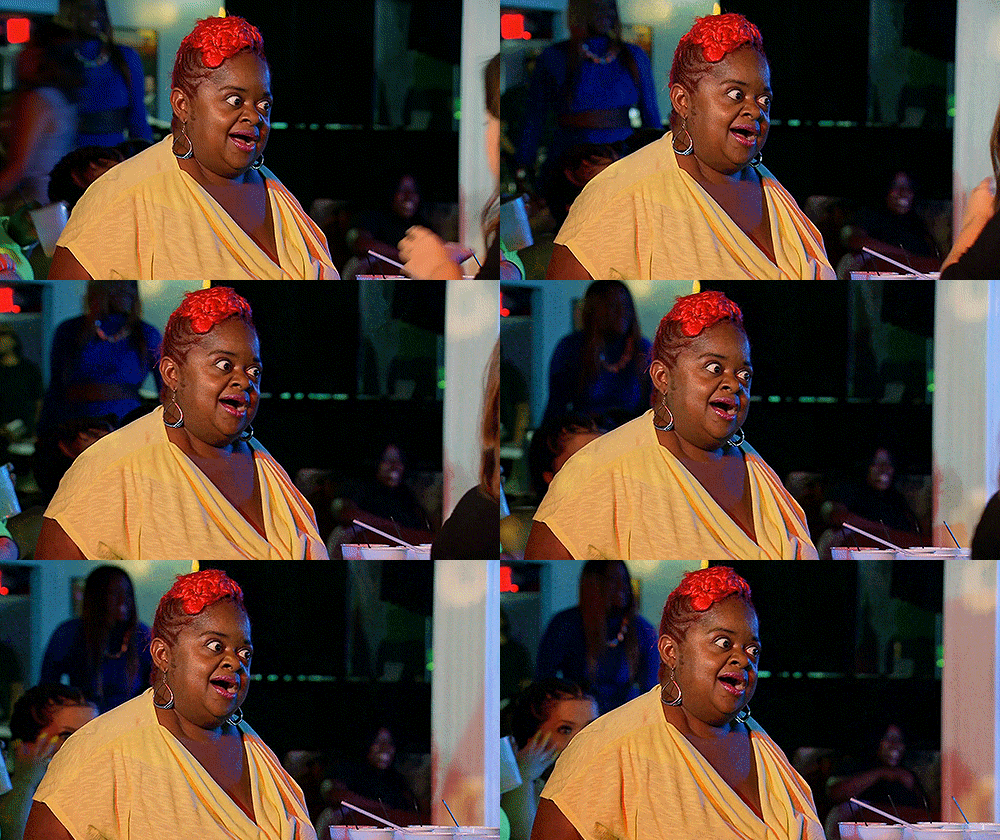
 The Chaos Bitches